2025 Federal Budget
Explore how the 2025 Canadian Federal Budget will impact you and your business.



Your search criteria returned no results.
With a focus on sustainable growth, resilience, and digital transformation, budget 2025 includes expanded renewable energy projects, modernization of transportation networks, accelerated digital infrastructure deployment, and enhanced support for community facilities.
Of note is the Build Communities Strong Fund, which commits $51 billion over 10 years starting in 2026-27 (including previously committed funding) to support local infrastructure. With this fund, housing-enabling infrastructure, such as building retrofits, health facilities, and improvements to post-secondary campuses, will be prioritized to address the build-out of local Canadian communities.
Designed to enhance access to international markets, the trade diversification corridors fund commits $5 billion over seven years to finance infrastructure projects that strengthen supply chains and support the efficient movement of goods across Canada and abroad. Projects of all sizes will be eligible, with particular focus on developing and modernizing ports, airports, and rail networks nationwide.
Another part of the government’s broader nation-building mission is the Major Projects Office (MPO), which will fast-track transformative energy, trade, and transportation projects across the country. The focus here is on large-scale, national-interest projects with high-impact infrastructure rather than routine community assets. These include the Sisson Mine for critical minerals in New Brunswick, the Crawford Nickel project in Ontario, the Ksi Lisims liquefied natural gas project in British Columbia, and the Iqaluit Nukkiksautiit hydro project.
Of special interest to the infrastructure sector is Bill C-5, the One Canadian Economy Act, which streamlines the approval of national interest infrastructure projects. As a result, MPO project approvals will be cut from five years to two years, with the MPO aligning approvals across multiple federal regulators to support speeding up projects.
In order to be successful, infrastructure proponents must be prepared for accelerated timelines, face tougher regulatory scrutiny, and more pressure to coordinate across federal, provincial, Indigenous, and private-sector stakeholders.
Now more than ever, Canadian organizations need a dynamic approach to infrastructure capital planning—one that integrates sustainability, technology readiness, and community impact. Strategic capital allocation will hinge on aligning projects with key federal priorities and a readiness to meet new standards.
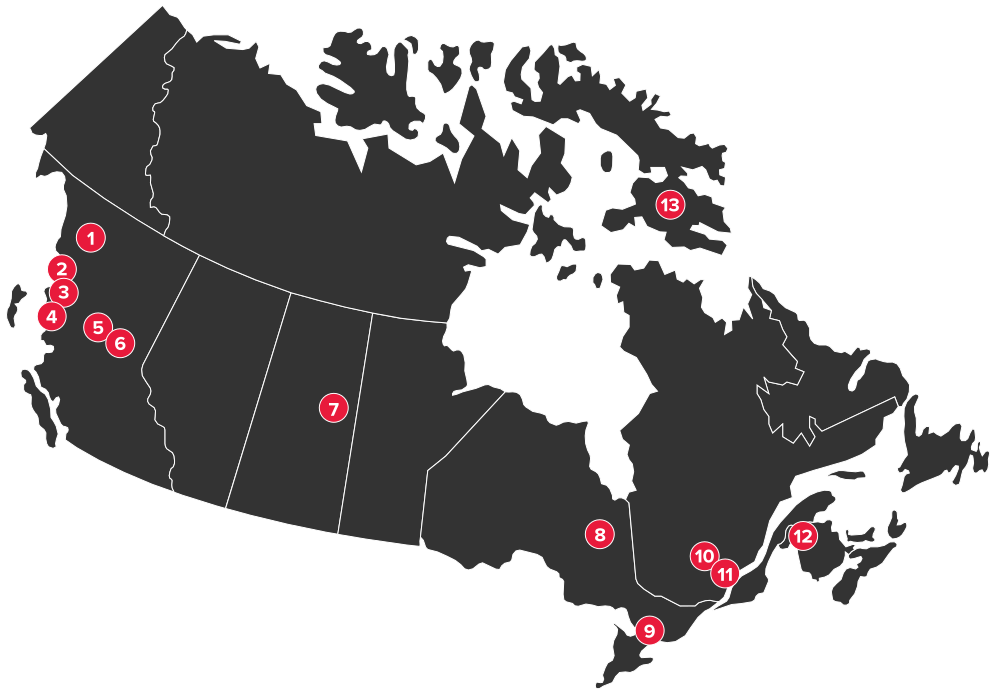
Map sourced from the Government of Canada website.
The 2025 federal budget commitment of $19 billion is a first step to close the Indigenous infrastructure gap, which is estimated by the Assembly of First Nations to be $349.2 billion.
Ongoing, meaningful Indigenous partnership and consultation is a requirement for infrastructure project success. The Major Projects Office is supported by the Indigenous Advisory Council, ensuring that partnership and Indigenous economic participation are central to all major projects advanced in Canada.
Smaller municipalities across Canada struggle to access and deploy funding as a result of limited staff and construction capacity. There may also be a lack of procurement sophistication, as well as difficulty attracting skilled contractors.
As a result, municipalities may need to collaborate in order to increase their purchasing power and secure access to federal funding as part of the Build Communities Strong fund.
Boosting clean electricity, strengthening methane regulation, supporting industrial carbon-pricing, and following sustainable investment guidelines are just some of the ways the budget proposes to strengthen Canada’s climate competitiveness.
As a result, and in order to move forward, infrastructure projects will need to align with net-zero and clean objectives. This may include transit electrification, green buildings, water and wastewater upgrades, and more.
The budget proposes $925.6 million over five years to support large-scale public AI infrastructure, to boost AI compute availability and support public and private research.
Digital infrastructure is taking its place within the larger infrastructure umbrella, and infrastructure proponents must be prepared for this shift.
While the budget allocates funding for local and Canada-wide projects, Canada does not currently have enough skilled labour or construction capacity to successfully execute the project pipeline. Many construction firms and trades are regionally concentrated, with provinces maintaining differing certification standards. This complicates cross-border movement for labour.
However, even with labour mobility reforms, there is still insufficient supply of labour. Infrastructure organizations will need to build workforce supply chain resilience and manage competition across provinces for skilled tradespeople and contractors.
While the 2025 federal budget has committed record investments in Canadian infrastructure, federal dollars alone won’t be enough. The government is adopting a Capital Budgeting Framework, which puts capital investment front and centre. It distinguishes day-to-day operational spending from capital investment—a distinction that could make projects more investable.
Canada is working to create a more dynamic economic environment to foster the flow of institutional capital back into the domestic market by expanding infrastructure financing tools. The infrastructure sector should expect and plan for a sustained pipeline of projects arising from a renewed interest in public-private partnerships. We also expect to see the rise of infrastructure-focused funds with private capital increasing interest in long-dated, stable and predictable cash flow investments, with embedded inflation protection and low correlation to the public markets.
While the budget and the MPO aim at cutting red tape and speeding up the regulatory processes, every player in this space will need to have a high level of political courage to call out when, where, and how federal, provincial, and municipal requirements are creating inefficiencies and playing towards risk avoidance versus risk management actions.
Traditionally, all levels of government have not been incented to take risks and fast-track approvals, but rather incented to follow the process, no matter how long that takes. Political courage, willpower, and leadership will be required to ensure that all levels of government can move to a speedy risk management approach that balances accountability, transparency, efficiency, and progress.
In addition to heightened requirements around meaningful Indigenous engagement, communication transparency, and sustainability outcomes, your organization must also pay special attention to evolving compliance requirements, supply chain disruptions, and capacity constraints.
These practical steps will position your organization for success:






Whether you need support with project eligibility assessments, funding application preparation, resilient sourcing strategies, procurement risk assessments, or more, our multidisciplinary teams bring sector expertise to ensure infrastructure projects are delivered on time, on budget, and in accordance with federal standards.
With a collaborative and data-driven approach, we are focused on delivering lasting value while supporting clients through every phase of the infrastructure lifecycle.
Contact our leaders to discuss how to align your capital plans and project proposals with current funding priorities, starting with a consultation to assess your project readiness, strategic positioning, as well as partnership and financing pathways.