


At a glance
- Global tax compliance has evolved from periodic filing to a core component of enterprise risk management and strategy
- Greater data sharing, mandatory disclosures, and compressed timelines heighten audit and reputational risk
- AI, automation, and centralized data architectures are redefining how compliance functions operate
- Leading organizations use compliance as a strategic feedback loop to protect ROI and build regulator trust
Regulatory risk and the new audit environment
With increased audit activity, there’s a global rise in audits across income tax, sales tax, and international tax matters. The more frequent and broader audit scope increases reputational and financial risk.
Enhanced data sharing between tax authorities under BEPS-related protocols has increased cross-border information sharing. Risky tax positions identified in one jurisdiction may now trigger scrutiny elsewhere. Compliance must now anticipate multinational visibility, not isolated local review.
Mandatory disclosure regimes, onerous reporting, and compressed timelines
Mandatory disclosure rules require reporting certain transactions to tax authorities. Reporting obligations may extend to both taxpayers and professional services firms with penalties for non-compliance increasing financial and operational risk. Compliance functions must incorporate real-time transaction monitoring.
Expanded reporting requirements including foreign affiliate reporting and interest deductibility forms can make the process more difficult. Forms require significantly more granular information, and many organizations lack systems capable of extracting required data efficiently. Compliance is now a data engineering challenge, not simply a tax technical exercise.
Filing deadlines are shrinking globally and the same volume of work must be completed in less time. Operational strain exposes weaknesses in systems and processes.
The tax technology disruption: AI and the reinvention of compliance
Tax compliance is inherently data-driven and standardized data capture enables automation of corporate and indirect tax filings. Further, offshore delivery models leverage economies of scale and lower labor costs. Compliance cost optimization remains a factor, but not the only one.
AI has the potential to fundamentally change how compliance is performed—shifting from manual data entry toward automated ingestion and analysis. AI models can assist in analyzing completed returns and identifying risk areas.
In the tax compliance function, many organizations are rebalancing their teams—automating routine data-entry work and increasing hiring for roles that can design, govern, and apply AI and analytics to compliance processes.
Managing compliance vs. using compliance strategically
Many organizations still treat compliance as a necessary obligation: a recurring requirement to file accurately and on time. In this model, success is measured by avoiding penalties and closing the reporting cycle efficiently. Compliance is managed, but it is not leveraged.
However, leading organizations approach it differently. They recognize that every filing is more than a regulatory requirement; it is a solidification of their tax strategy. Compliance consolidates financing decisions, transfer pricing methodologies, supply chain structures, and cross-border investments into a defensible position presented to regulators. It is a real-time audit of the organization’s global tax posture.
When viewed through this lens, compliance becomes a strategic feedback loop. This shift changes behaviour. Tax is brought into transactions earlier. Data systems are designed with reporting integrity in mind. Transfer pricing, financing structures, and operational substance are continuously aligned rather than periodically reconciled.
The distinction is subtle but significant: managing compliance is about completion. Using compliance strategically is about control.
In an environment defined by harmonized rules, real-time data sharing, and AI-enabled enforcement, the latter is no longer optional. It is a prerequisite for maintaining resilience, protecting ROI, and sustaining regulator trust.
Organizational implications
Organizations are navigating increasingly complex governance and risk management challenges, requiring a more integrated and strategic approach. Compliance must be embedded within the broader enterprise risk management framework rather than treated as a standalone function. At the same time, there is a growing need to invest in systems and infrastructure, particularly through the development of centralized data architectures that enable consistency, transparency, and control.
Alignment between ERP systems and tax reporting requirements is critical to ensure data integrity and regulatory accuracy. Additionally, tax technology and AI integration should not be implemented in isolation; they must be deliberately woven into the organization’s overall strategy to drive efficiency, enhance oversight, and support long-term resilience.
Tax leaders are seeing it in action too as they unanimously report markedly higher scrutiny and expect it to intensify, driven by greater regulator collaboration, pressure to curb abuse of the tax system in a time of growing inequality and economic stress. Organizations must therefore maintain higher standards continuously to maintain positive relationships with tax authorities.
There are structural shifts within organizations as well. Our Global Tax Outlook 2025 highlights how teams are spending more time answering tax authority questions—all elevating risk.
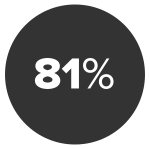
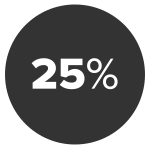
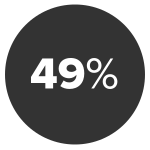
This signals a resource strain and operating model redesign should be considered.
An adversarial stance prolongs reviews and drives up costs. Regulators increasingly reward transparency and timely voluntary disclosure. Success depends on trust, thorough documentation, and advisors aligned to the company’s strategy and risk profile.
Sector spotlight
Manufacturing
Manufacturing is heavily impacted by geopolitical shifts and territorial policy changes with limited operational agility that increases tax exposure. Relocating production is often a multi-year planning exercise.
Transfer pricing becomes central in this context. As manufacturing footprints shift, profit allocation across borders changes, and movements from high-tax to low-tax jurisdictions increase scrutiny. This may result in local governments using analytics to flag high-risk transactions.
Customs valuation, origin, and tariff classification are high-priority issues. However, changes in customs value can directly impact transfer pricing. Governments are increasingly testing whether operational substance aligns with documented tax structure. And misalignment between transfer pricing documentation and operational reality invites challenges.
Infrastructure
The infrastructure industry is particularly sensitive to tax policy because it relies heavily on leverage and capital-based incentives to drive returns. As a result, changes to interest deductibility rules, capital cost allowance regimes, and other local country tax reforms can materially alter after-tax ROI. Furthermore, obtaining access to government tax credits and/or other incentives in the clean energy space can materially influence overall project economics.
At the same time, layered ownership structures add complexity and expand compliance obligations. The long asset lives typical of infrastructure projects magnify the impact of regulatory shifts over time. Compounding this, BEPS-driven reforms have changed the landscape of cross-border planning strategies, requiring greater coordination across jurisdictions and closer alignment among member firms to manage risk effectively.
Compliance as competitive advantage
Regulatory complexity is unlikely to reverse, while global transparency and coordination will continue to expand.
Organizations that treat compliance as a strategic infrastructure investment will:
- Reduce audit risk
- Improve speed and accuracy
- Enhance effective tax rate management
- Enable more confident global expansion
Tax compliance is no longer a back-office function—it is a core component of enterprise resilience and strategic execution. The organizations that adapt first will not simply comply, they will compete. Schedule a consultation to explore how your business can move beyond standard compliance.
To discuss how BDO may assist your organization, please contact:
The information in this publication is current as of March 10, 2026.
This publication has been carefully prepared, but it has been written in general terms and should be seen as broad guidance only. The publication cannot be relied upon to cover specific situations and you should not act, or refrain from acting, upon the information contained therein without obtaining specific professional advice. Please contact BDO Canada LLP to discuss these matters in the context of your particular circumstances. BDO Canada LLP, its partners, employees and agents do not accept or assume any liability or duty of care for any loss arising from any action taken or not taken by anyone in reliance on the information in this publication or for any decision based on it.